
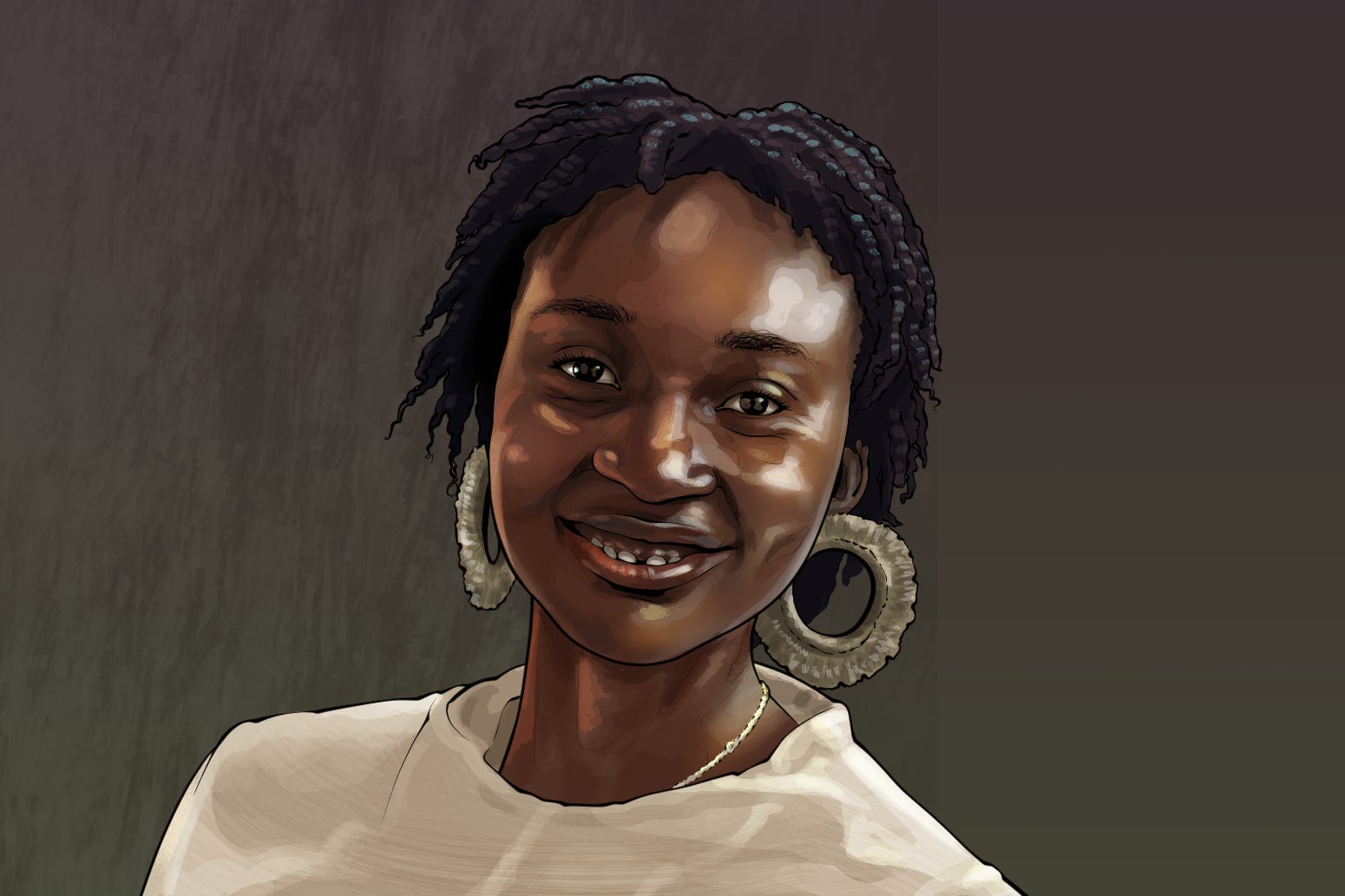
How Tomi Adesina is holding the government accountable
"It’s not necessarily an attack on anybody but more a discussion amongst ourselves about how we want to live."
In April, Tomi Adesina wrote about traffic gridlock in Lagos. She called on all Lagosians to join hands in demanding and creating public infrastructure that “serves human dignity rather than undermining it”.
Then, last September, Tomi’s Lagos apartment was flooded after heavy rains.
“I wrote about systemic failures and the endurance of Lagos residents who navigate broken infrastructure daily,” she wrote on her blog after the flooding. “I had no idea I was writing my own future.”
In response, Tomi, who is a product strategist at Paystack, called for more Lagosians to document their flooding experience. She also created a form for fellow citizens to connect with one another and engage the government.
“Building the Lagos we need requires reimagining the relationship between government and citizenry,” Tomi blogged.
Recently, I spoke to Tomi via Google Meet. The transcript of our conversation, edited for clarity and brevity, is published below.
READ ALSO: Kọ́lá Túbọ̀sún on what it means to be Yoruba
READ ALSO: Tolu Daniel on the dialogic violence of Yoruba nationalists
Omon Okhuevbie: Can you briefly introduce yourself, what you do, and where you stay in Lagos?
Tomi Adesina: What’s the best way to introduce myself? I guess my name is Tomi. Tomi Adesiina. I’ve been living and working in Lagos for the past six years now. I’m currently living in Lekki. I moved here less than six months ago, but I also faced similar challenges in Ogudu. The quality of housing is so low, which is what keeps making me move around.
OO: Do you work in Ikeja GRA?
TA: Yes.
OO: Okay.
TA: Yes, so I’ve been working in the same place for the past six years also, so I guess that’s why I’ve worked mostly in Ikeja.
I work at Paystack. My role at Paystack is in strategy and operations. The best way to describe that is, I incubate new teams and ideas. So if there’s something new that we want to create, you can work with someone in strategy and operations. OO: That’s interesting. Do you enjoy it? It seems like you like writing more.
TA: Yes, my work involves a lot of writing. That’s why I write. I don’t think I’ve ever written as a separate thing; writing is the job, writing is how you communicate with people and work with different people across teams.
OO: You wrote on your blog that what began as an observation became a lived experience. What moment made you realize that the flooding was no longer a distant story but your own reality?
TA: I mean, flooding was already my reality before I moved. That’s what has made me concerned about infrastructure in Nigeria, and especially in Lagos since this is where I am. What I was alluding to with that statement was that when it was flooding in the past, the areas I was around would just get a mild pooling of water. It wouldn’t really flood per se. But then I moved to this place and literally from the first month, it was already flooding on the streets. So I was already looking for a new place even before the house itself flooded.
The house flooding has now made my move a bit more imminent. I need to move desperately, but I still can’t move because I can’t find a place. It’s tough. I spend a lot of time outside of the house because there’s still mold in the house and I don’t want to get sick from it.
OO: So, living through the flood, how has it reshaped your understanding of Lagos, both the people and the government?
TA: I think that’s an interesting question. It wasn’t just the flooding, it was the flooding and the way people reacted, the way there was no intervention.
I think we as Nigerians always think that bad and sad things are far from us, and we hope and we pray, which is very interesting. We never prevent it. We just sort of say, ’as long as it doesn’t happen to me’. It just made it very clear how normal we think dysfunction is. Like, we just think, ‘ah, this is happening because this is how things are’.
And this is not even about people that didn’t experience flooding. Even within the estate, trying to get people to share their own images or complain about what got damaged in their places was hard because most people have just moved on.
During the crisis moment, everybody was looking for help, for how to get food or water; everybody was supporting. But the moment the water went down, it was back straight to regular programming, just silence, everybody doing their own thing.
And I don’t want to operate like that. I don’t want to operate around people like that. If it means I need to create and cultivate a community around me in the next place that I live, that’s what I’d rather do. It’s a shame I can’t do that here because I’m not interested in staying here now. I too need to conserve energy from all that’s happened.
From a government point of view, I think what’s most interesting is realizing how manual their processes are. I had a vague sense of it but didn’t realize how bad it was. All of the ginger I thought I’d use to rally people and demand change, I had to change my approach. Nothing’s going to change that kind of process overnight. So, the work is really about documenting thoroughly and over a long period of time, so that there are undeniable facts, clearly published. So that’s what I’ve been meeting different groups of people about. One key one I’m focusing on right now is with a lady, Hannah, who used to work at a data company called Stears. She now runs her own company called Public Tech Studio.
OO: Is it Hannah Kates from Stears? I’ve worked with her on a piece about the ferry map in Lagos.
TA: Yes, exactly. So similar to that. As you can imagine, it’s very aligned – thinking about infrastructure in Lagos and what happens when we have or don’t have it. I’m working with her on that. We’re creating a sort of help desk, curating resources for other civil society groups.
For instance, Enough is Enough has a page listing local governments and chairmen, but it doesn’t get updated. So we need to rally volunteers to help keep that updated. There’s also Tracker NG designed by BudgIT, that lets people follow government projects around them. If you see a government project, you can take a picture as a champion in your area, and others in the area can follow it, and that can be a way of holding the government accountable over time, over that particular project.
Then there’s something called Citizens’ Gate in Lagos; it actually doesn’t work. Citizens’ Gate is supposed to be our own version of New York’s 311. If you are experiencing fire or flood, you are supposed to be able to call them; but the help desk doesn’t work. So what we’ve now put there as the alternative path to solving that problem is the path that I chose, which is going to Alausa and submitting a letter. So, we created a template version of the letter that we put up.
OO: Yes, that’s so nice, because I think it’s important for citizens, especially residents of Lagos, to hold the government accountable. It’s an impressive job you’re doing.
TA: Thank you. One of the more interesting things for me is a conversation hosted by HOAQ Investment Group and Star Network Podcast.
OO: No, I don’t know them.
TA: You should check them out; two of my former colleagues run those brands.
OO: HOAQ Podcast?
TA: No, HOAQ, and then there’s Star Network Podcast. They’re two separate entities; one is an investment group.
OO: Okay, thank you.
TA: So essentially, they hosted a roundtable where they invited some government institutions, investors, and others to discuss what could potentially make this place better. When I say this place, I mean Nigeria. One of the things that stood out to me was something someone said about the government. Government is almost like saying ‘business’. Who is the business? Who is the government? All we have are laws and citizens. Those laws empower some citizens to represent others; that’s what we call the government.
So in itself, the government isn’t something to be angry at. It exists and perpetuates itself; it doesn’t by default solve problems. The more people understand that, the better things can be, because we can have higher taste. I think a lot of our suffering in this country is because people don’t really like nice things. We like nice things when influencers come and tell us that something is nice. Maybe and that’s a strong maybe.
OO: We are so quick to settle for the bare minimum.
TA: Exactly! Like the betting pandemic that we have in this country; we think we’re only betting with money, but we’re betting with infrastructure, education, and politics. We are betting with our lives.
OO: In your essay, you called the flood ‘an act of government dressed up as development’. What policies or decisions do you believe directly caused this flooding crisis in Lagos?
TA: To be fair, I’m not quite knowledgeable in terms of what exists; what doesn’t exist is what I am aware of. We don’t have organisations accountable for core infrastructure regulation. There’s no reason why buildings should collapse after a short time, or at all. No reason why roads are getting bad, no matter how many times they get fixed. No reason why cars that are wrecked to the bottom of the barrel are able to move around on the road while police stop regular cars for whatever reason it is.
So I think, it’s what doesn’t exist that annoys me more so than what exists, because what exists are often old things that we never changed. And there’s a chance that if we even adhered to some, we might be in a better place. But there’s no way to know because again there’s no way to hold anybody accountable and there’s no one taking ownership and trying to solve any of these problems on any level.
The only thing that gets done is maybe when somebody gets exposed and they don’t want to be called out on social media. So they will pay attention for a little while but again something new will come up and then everybody’s attention will sort of shift.
Even me, I can see how my own regular life will not allow me to pay attention to this problem as much. It is just because very early on, I committed that my involvement will be minimal, so that it can be sustainable. I will do what I can and publish an update at least every two or three weeks, so that I can keep the light burning; but I won’t try to go full force. If not you will just burn out and then you won’t be able to continue the work.
The other things I think are decisions around urban planning, how the state is designed and decisions around infrastructure and how we both as citizens and the people who are in charge of issuing permission are involved. It is almost like we like to get our way as Nigerians and we will lobby for anything without thinking of the consequences. And as long as money can shift hands, so that we can get what we want done, we do that. And that’s what has been happening and now we now have so many layers of that that have happened. At this point, a decision to break up a place or not is so tough unless we do it on a grand level and again there’s nobody who is being accountable and taking ownership. of doing that trying to redesign like a different kind of Lagos at the very least, talk less of a different Nigeria.
There’s a world where increasing transportation access and security around neighboring states makes things easier. But since everybody’s working in isolation, governments and sub-governments, and even the people that are involved are also selfishly trying to figure out how they can make the most amount of money. I wouldn’t be surprised if there are people within the same household that are competing with each other.’ Tthat’s how we are as Nigerians. And so it’s just very hard for us to have a coordinated effort towards a better country.
When I say government sometimes – I can be very poetic in my writing – I’m never talking about any one group of people at any point because I think we’re capable of being everything. We can be anybody in this world, we just happen to be the people that we are just because of our upbringing and how that shaped our insights. So, the way we express ourselves can be slightly different; but if we were put in a separate situation,, the way we will react to the world will also be different. We also have to think about that when we’re thinking about designing the world that we want, that our future generation of people will live in, because that experience will shape the kind of people that they become and the kind of choices that they make.
OO: So from your perspective, how should state officials have responded to this flooding disaster? What does that reveal about Lagos’ crisis management system?
TA: We do have crises, we have reactions to crises but we don’t have a crisis management system. Even if all the officials were great, everybody was responsive, and everybody wanted to do everything, having bad roads alone, having uncontrollable traffic alone, it nullifies the idea of a crisis management system.
In the first essay that I wrote, there were literally just fires in UBA that killed some of the staff. What do you want to say about that? That one is not even water because water is a bit more pervasive than fire. Fire will burn when it catches and then you will know what you have lost. With water, you don’t know what you have lost until the time has passed. Like this estate now, they don’t know what they’ve truly lost. They are going to be finding out continuously for a long time, all the appliances, all the pumps, all the reservoirs, all the electricity panels, everything they will be replacing. I’ve been seeing the trend of messages that’s coming on the group chat, there will be new things that they will find out that they need to replace. With fire everything will get burnt but with water. you will just be fixing inconvenience until everything is slowly replaced.
OO: You write about documentation as a resistance. How do you think writers, journalists, even community media can use storytelling to drive social and political change?
TA: This one is very interesting because I’m also finding out. The best way I can answer this is what I’m attempting to do. What I’m attempting to do is figure out a good way to translate all the sentiments and comments and topics that I think we should be addressing or thinking about as people in lighter and softer ways. Ways that are easy to have in any kind of random conversation.After the flooding, I went shopping for clothes because I could not get to my house for like four days after the flooding.
I started a conversation with one of the store managers in the place I went to get clothes. She was saying something about how this country is so depressing and how it will make you wonder if you’re not good at making good decisions about your life, especially if you’re somebody that is not really thinking of relocating or japa. For her it was just very helpful that I was affirming her thoughts because I was just like, I like this country, my house also flooded but I’m not going to let it kill my spirit because it’s not because of me that the flooding happened. People need to see that they are not the problem and the problem is not necessarily insurmountable, like there’s a way to solve this thing and part of solving that thing is articulating your complaints well and coordinating with other people like you so that there’s a higher chance that there’s a solution.
I guess the summary for me is what writers and storytellers can do is make these topics easier and more publicly discussed. It’s not necessarily an attack on anybody but more a discussion amongst ourselves about how we want to live, how we want to be, what we want to ask for and what we don’t want to ask for. I think that’s what writers can do and just tell everyday stories more and more about this thing.
Sometimes people don’t know what they are losing out on because they don’t have space. They’re just going through the chaos and there’s more that is coming up every day. By the time you are done with clearing the water in your house, you go to buy fuel, the fuel price has changed. Your problem will just shift, so you will not pay attention to that original problem; but if there’s somebody who is very keen and aware of your own story and keen about that aspect and how you are doing and how it’s working. Then it can be interesting to figure out how you resiliently got out of something that was potentially disastrous, giving somebody else hope that they can do the same. You can potentially show somebody a different place to live because like somebody was looking for a place to live but doesn’t know, and then somebody else who figured it out, can have a pathway to figure out how they can do the same.
I think storytellers can do a good job by creating connections within communities using stories, so that people don’t feel alone and separate and isolated in these experiences.
OO: If you could outline one urgent step that the Lagos state government should take to prevent a repeat of this flooding, what would it be?
TA: I’ll deploy drainage engineers to evaluate the key draining channels across Lekki line by line. Literally just take the main expressway and then deploy engineers to write reports on the state of the drainage systems. It doesn’t even have to be grown engineers, it can literally be a batch of engineering students that are managed by an inspector from the drainage office or something like that. They can make a good project out of it, like an early Saturday morning and everybody just does it and they are just stationed across and they do it all at once, they upload the reports all at once and everything is ready. Then, the interaction can now become ‘this is how we are prioritising, based on the kind of havoc’.
I’m not asking for an instant fix, I’m asking for a trajectory towards solution. That I think would be a fantastic start because then when we are thinking about where money should go from a tax point of view, we are looking at a prioritised list of problems. Problems that all of us know exist and we can track and we can see. We can upload all those projects on a place like Tracker NG. Then the surrounding communities can join as project champions and see, and give regular updates over time to see if anything is changing in relation to solving that problem. So, if the government is saying that they are solving, there are people on ground that are also saying yes, that is true.
OO: Despite everything, what still gives you hope about Lagos and its people?
TA: I have hope in humanity as a whole; our default as humans, as complex beings in this world, allows us to aggregate to an ideal state of flourishing. I anticipate the same for us in Lagos and Nigeria as a whole. My hope and efforts are actually towards making sure we don’t have to hit rock bottom before we decide to be and do better. I’m leaning into my strengths of noticing and writing and hope to do that across a few relevant themes as long as I reasonably can.
OO: What is one lesson this flood has taught you?
TA: I have learnt many things from the flooding and the impact of flooding. The biggest learning for me was the importance of risk management. Life is very unpredictable by design. Our attempts to organise the world for our own convenience give us the illusion that we can predict everything. While I knew this area had bad drainage, I could not have predicted the devastating flood on that random Tuesday afternoon. I wished I was more prepared overall and perhaps with insurance. I’ll be taking note of that for my next space. I found that there are insurance options for householders or tenants to protect their belongings from theft or damage due to water or fire.
OO: What is one thing every Lagos resident should understand about governance?
TA: That governance is our collective responsibility. The people we refer to when we say ‘government’ are really our representatives. So a proper understanding of governance requires all Lagos residents to embody the essence of leadership on an individual level. It is that kind of ownership that allows us to want and choose better representation for ourselves when we need it. We have laws, we are all citizens, and we can all hold ourselves accountable. My recommendation to everyone is that we all pay attention to our daily lives enough to start to question things we don’t understand and untangle complex issues we typically ignore as a way to learn how this city and the people in it actually work. When we have more clarity about what we have, we have a better chance at removing what we don’t want and adding what we want. ✚


