



The Lagos State Government paid at least ₦43.57 billion for the Visionscape waste management project despite terminating the initiative before its completion.
Although Visionscape operations effectively ceased in 2018, the state government continued to make payments for the project until at least 2022.
This is according to documents obtained, verified and reviewed by Ìkẹjà Record. (See below for a methodology note on how we calculated the project’s cost to the government).
The ₦50 billion Visionscape project was designed to modernize the state’s waste collection process before political forces kicked out the Akinwumi Ambode administration in 2019.
Previous reporting has suggested Visionscape did not possess the technical capacity and track-record to implement the project, with concerns raised by civil groups over “allegations of economic fraud, incompetence and dubious dealings.”
According to a person familiar with the project’s struggles, political leaders also saw Visionscape as a ploy to wrestle the state’s ‘political infrastructure’ from the ruling All Progressives Congress (APC). Ìkẹjà Record could not independently verify this claim.
The Sanwo-Olu administration did not respond to Ìkẹjà Record’s requests for a comment.
Recently, the state’s waste management system has become overwhelmed, returning to similar scenes experienced during the Visionscape era.
The Sanwo-Olu administration has cited poor planning on its part and pointed fingers at residents for illegal waste dumping and non-payment of fees.
The Sanwo-Olu administration is also partnering with ZoomLion Nigeria to transform some of the state’s major landfills into modern transfer-loading facilities.
On September 9, 2026, Governor Babajide Sanwo-Olu declared a state of emergency over the waste management issue.
‘Highly experienced’
In March 2017, the Ambode administration issued an Irrevocable Standing Payment Order (ISPO) to Visionscape, through the company’s special purpose vehicle, Municipality Waste Management Contractors Limited (MWMCL).
An ISPO is a financial instrument through which a borrower, in this case MWMCL, can secure loans from the Capital Market.
However, this type of loan cannot be cancelled or re-negotiated by the borrower without the consent of the lender and payments are usually made on a fixed-term basis.
The Visionscape ISPO was worth ₦50 billion and guaranteed by the Lagos State Government.
In June 2017, Global Credit Rating issued a bond analysis for the Series 1, amounting to about N28 billion.
Agusto & Co., a credit rating agency, assigned an A+ score to the debt instrument.
“The approved ISPO authorizes monthly remittance of N713.7 million from the State’s internally generated revenue (IGR), commencing in June 2017, into a designated sinking fund account (SFA) to meet the obligations of the Note,” Augusto & Co. said it in its rating assessment.
The rating also noted that Visionscape was expected to collect at least 60,000 tonnes of waste every month.
According to Agusto & Co.’s rating, the Visionscape team was “highly experienced in the management and collection of waste” and the project “has a satisfactory cash-generating capacity.”
However, the rating note also warned that “getting the buy-in of the residents of the State may be potentially challenging.”
‘Acts of sabotage’
After Visionscape took over waste management duties in 2017, refuse blackspots took over Lagos, raising fears of a health epidemic.
One commentator said Visionscape lacked the necessary manpower to prosecute the project. An official representing PSP operators, a group of private waste collectors replaced by Visionscape, declared Lagos as one of the dirtiest cities in the world. In an editorial, the Punch Newspapers described the waste situation as a “nightmare”.
Meanwhile, the Ambode administration – without providing evidence – accused anti-progressive elements of creating blackspots across the state in an attempt to sabotage the Visionscape project.
By October 2018, the Visionscape project had become a major campaign issue during the APC primaries.
“Lagosians want an answer to the sanitation crisis and loss of jobs caused by Mr. Ambode’s Visionscape misadventure,” Governor Sanwo-Olu said at the time.
Days after Mr. Ambode conceded defeat to Governor Sanwo-Olu in the APC primaries, the media reported that Visionscape was shutting down its operations in Lagos.
Calming anxious investors
Despite suspending the Visionscape project, the state government was still required to meet the Series A bond obligations incurred by MWMCL.
In April 2019, Proshare reported that the government may have missed a payment, sending bond investors into panic mode.
To assuage the worries of lenders and protect its credit rating, the state government sent a letter to Augusto & Co and GCR ratings, its Capital Market partners.
In the letter, signed by the Accountant-General, Tajudeen Mahmud and dated November 1, 2019, the state government assured investors it would meet its obligations.
“Under the initiative, Lagos State issued a guarantee in the form of an ISPO (Irrevocable Service Payment) for the sum ₦713,700,000 (Seven Hundred and Thirteen Million, Seven Hundred Thousand Naira only) per month in favour of Municipality Waste Management Contractors over 120 months which is the duration of the contract,” the letter read in part.
“Following the political reaction to the engagement of Visionscape and matters arising as a result of the implementation of the CLI program, the initiative has to be discontinued and Lagos State Government took over the assets procured with the bond proceeds by Visionscape and the outstanding liabilities to the bond holders.
“Lagos state had an understanding with the bondholders to pay off the liability by September 2022 with the continued payment of the ISPO.”
Methodology: How Ìkẹjà Record calculated the ₦43.57 billion figure
Ìkẹjà Record calculated the cost of the Visionscape-related debt by reconstructing the principal and interest payments on the three Series 1 bonds issued by Municipality Waste Management Contractors Limited (MWMCL), the special-purpose vehicle established to finance the Cleaner Lagos Initiative.
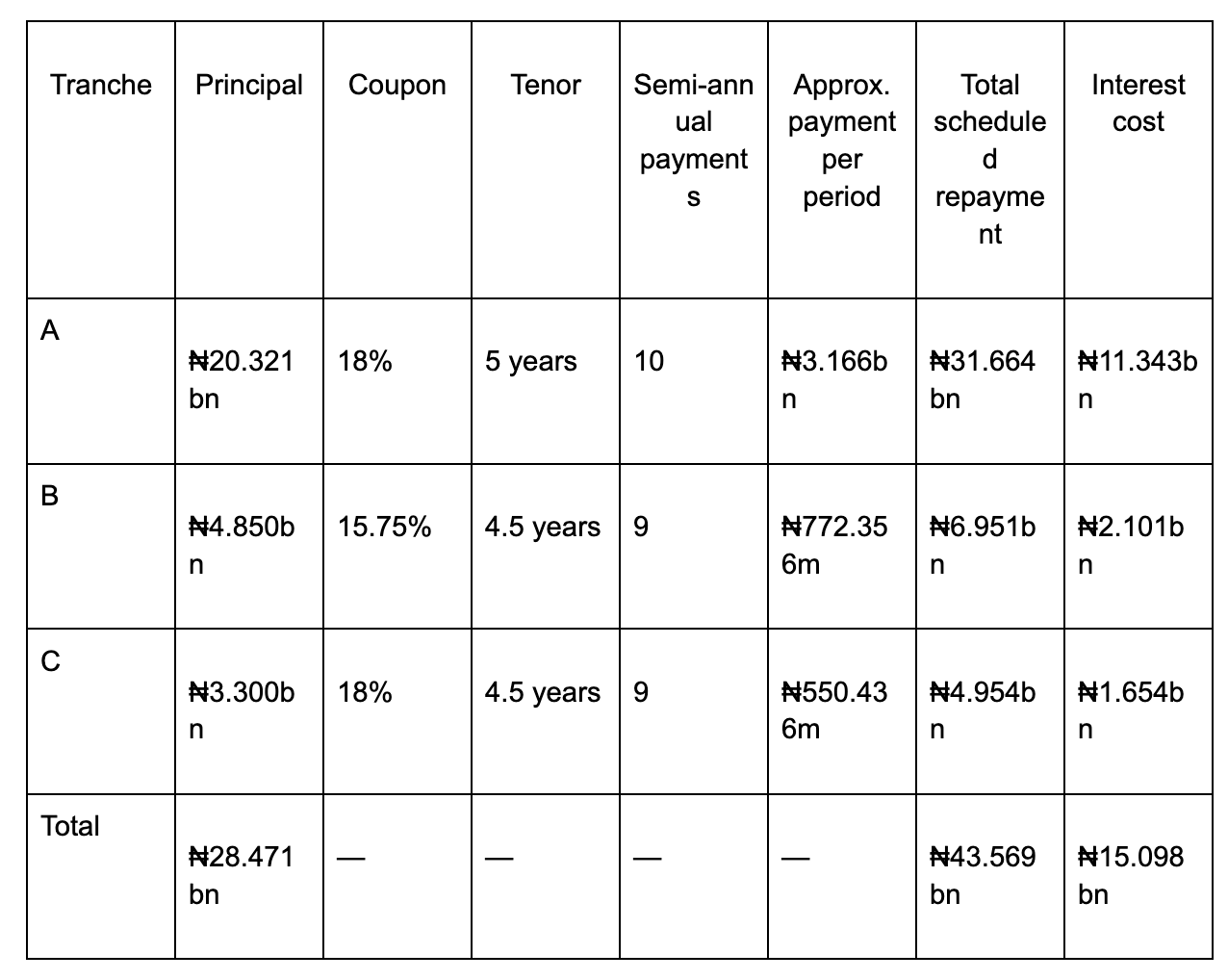
The combined ₦28.47 billion issuance was recorded by GCR Ratings. The Securities and Exchange Commission separately confirmed that the bonds were issued by MWMCL under a larger ₦50 billion Medium-Term Note Programme.
The securities were amortising bonds, meaning each scheduled payment contained both interest and a repayment of principal.
For Tranche B, Ìkẹjà Record did not estimate the repayment schedule. The bond’s Supplemental Information Memorandum, reproduced in Proshare’s analysis of the note, states that the ₦4.85 billion bond was repayable in nine equal semi-annual installments. The published schedule gives a payment of approximately ₦772.36 million every six months. Multiplying this by nine produces approximately ₦6.95 billion in total payments, of which ₦4.85 billion was principal and approximately ₦2.10 billion was interest.
Complete amortisation tables for Tranches A and C were not publicly available. Ìkẹjà Record therefore reconstructed their scheduled repayments using the standard amortising-debt formula, P × i ÷ [1 − (1 + i)⁻ⁿ], where P is the amount borrowed, i is the semi-annual interest rate and n is the number of semi-annual repayments.
For Tranche A, applying an annual coupon of 18 per cent to ₦20.321 billion over 10 semi-annual periods produces payments of approximately ₦3.166 billion every six months, or ₦31.664 billion over the bond’s life.
For Tranche C, applying the same 18 per cent annual coupon to ₦3.3 billion over nine semi-annual periods produces payments of approximately ₦550.44 million every six months, or ₦4.954 billion in total.
The three tranches therefore required an estimated ₦43.57 billion in scheduled principal and interest payments: ₦28.47 billion in principal and approximately ₦15.10 billion in interest.
After the Visionscape initiative was discontinued, Lagos State said it had assumed the outstanding liabilities and would continue servicing the bonds through its Irrevocable Standing Payment Order. Subsequent reporting states that the state continued servicing the obligations through their September 2022 maturity.
The ₦43.57 billion figure is therefore a reconstruction of the bonds’ scheduled principal and interest payments, rather than a figure (or figures) appearing as a line item in Lagos State’s accounts. It excludes transaction fees, penalties and any default interest and may therefore understate the overall financing cost. ✚
Our analysis was actively supported by the use of Large Language Models. Ikeja Record takes final responsibility for any errors. Subscribe to support our local journalism.