
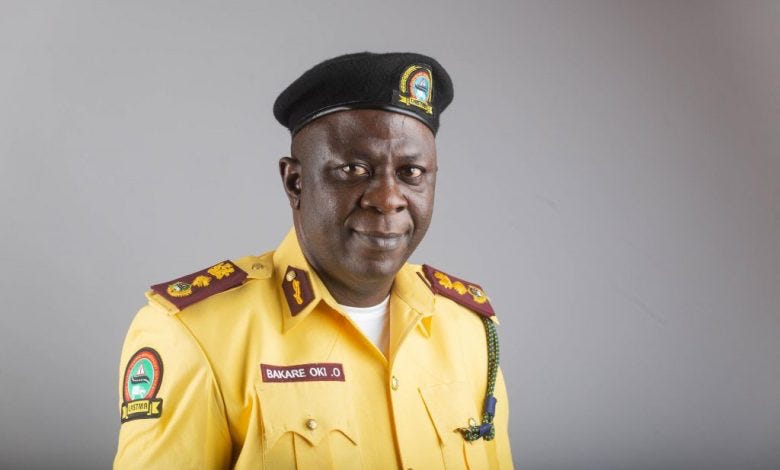
Bakare-Oni Olalekan on how LASTMA trains its officers to reduce misconduct
Earlier this year, the Lagos State Traffic Management Authority announced it has sanctioned 19 of its officers over misconduct.

Earlier this year, the Lagos State Traffic Management Authority announced it has sanctioned 19 of its officers over misconduct.
According to the agency’s General Manager, Olalekan Bakare-Oki, the disciplinary measures were taken by the Lagos State Civil Service Commission.
However, LASTMA’s role in the process remained unclear.
To find out how the agency ensures its officers – who are ubiquitous on Lagos streets – are properly trained and equipped for the job, Ikeja Record’s co-editor, Omon Okhuevbie, recently spoke to Mr. Bakare-Oki.
The interview transcript reproduced here was edited for clarity and brevity.
READ ALSO: Kọ́lá Túbọ̀sún on what it means to be Yoruba
READ ALSO: Tolu Daniel on the dialogic violence of Yoruba nationalists
READ ALSO: How Tomi Adesina is holding the government accountable
READ ALSO: Q&A: What Nigeria’s new tax regime means for workers and businesses in Lagos
Omon Okhuevbie: Sir, recently 19 officers were sanctioned for misconduct. Some were dismissed, and others demoted or issued formal warnings. How does LASTMA use these processes to improve its training programs and professional standards?
Olalekan Bakare-Oki: In LASTMA, especially when I became the general manager in late November 2023, I went into the boardroom with my core directors – those at the topmost level of the agency – in order to dissect the challenges in the agency, especially how to reposition and rebrand the agency for better service delivery to Lagosians. So, part of what we identified happened to be indiscipline on the part of our men. We then prioritized training and retraining of our men.
In 2024, we drew up a program, a robust and aggressive training system. It includes internal and external facilitators, from January 2024 to December 2024. We replicated the same thing for last year, 2025. This year, we have a drawn up program from January to December. On a weekly basis, we bring our men from the field into the classroom, training them and reorientating them.
We collaborated with a lot of consultants, including the NOW Training Institute. The last one we did was with MacTay Training Institute. They have their office around the Lekki-Ajah axis. We equally collaborated with a leadership training institute in South Africa. They came here to take our men, especially those on management level, on leadership training.
However, officials at lower cadres, especially those on the field, were the main targets, because they are the face of Lagos State. The majority of Lagosians using the road will always see LASTMA coming through them. So, we concentrated on soft skills and emotional intelligence. We equally took them on ‘enforcement without aggression’ training. There is what we call ITS, Intelligent Traffic System, which is an advanced form of traffic management.
For the external training, we also collaborated with Lagos State Police Institute in 2024. We took over a thousand of our officials for physical fitness training. The police took them on parade routines and other activities. LASTMA was intentional about this. It was a deliberate attempt in building our human capacity.
All over the world, globally, building human capacity will surely yield positive fruit. And you must agree with me, this has been yielding a lot of results since we started in 2024. You must have seen it in the conduct of our men, how they behave on the road. Apart from training, retraining, and reorientation, we equally prioritize discipline, because it happens to be part of our challenges over the years.
I and my team had to rejig the provost and the surveillance departments. Their core responsibility is to move around Lagos where our men are positioned. In LASTMA, we have almost 4,500 personnel; so we are well spread across the states. So the core duty of the provost and surveillance units is to move around like a mystery shopper, unidentified, with unbranded vehicles, so that we will be able to monitor our officials in real-time.
In 2024, the agency also commissioned a digital toll-free line, so that we will be able to get real-time feedback from the public, especially regarding the conduct of our men on the road. Also, they equally give us information on accidents and emergencies. At times, they call to commend us. But the majority of the complaints, if not 100%, were promptly dealt with.
The activities of the provost units, surveillance units, and the feedback we got from the toll-free line cumulatively resulted in ensuring that we took 19 personnel for 2025 to the disciplinary board in Alausa. In Lagos State’s public service, any erring officers that are found wanting in the course of duty, the disciplinary process is for you to go through the Lagos State’s public service route. So after due diligence, some of them were given outright dismissal. Some were given demotion. Some of them were given compulsory retirement, while they gave others strict warning letters.
Omon Okhuevbie: Can you walk us through the recruitment process for LASTMA officers?
Olalekan Bakare-Oki: The recruitment process is direct and simple. Whatever we do here, we do it in accordance with Lagos State’s public service rule. It’s the same thing statewide. LASTMA is not an exception.
For senior officers, they have to go through Lagos State’s public service route. While for the junior rank, we call the office PSO, Office of the HOS and the staff that are in charge of the junior officers. For senior officers, it has to come from the Lagos State’s public service commission. So we don’t have any right to recruit directly.
Omon Okhuevbie: What does the initial training for new officers involve, and how long does it last?
Olalekan Bakare-Oki: What do you mean by initial training? Do you mean start-up training?
Omon Okhuevbie: Yes sir.
Olalekan Bakare-Oki: Anybody that has been recruited into LASTMA must go through a mandatory training for a minimum of three months. Before such officers are to be put on the road, we must have taken them through the rudiments of the activities of LASTMA.
Omon Okhuevbie: I think you’ve mentioned that already, I wanted to ask you if ethics and public engagement are part of the training curriculum for new recruits?
Olalekan Bakare-Oki: Of course, of course. We do that a lot. And for this year, 2026, we have started. We have our timetable, and it’s going to last until December 2026, God willing.
Omon Okhuevbie: So, how do the reports from the public factor into identifying misconduct among the officers?
Olalekan Bakare-Oki: Okay, as I told you earlier, the agency commissioned a toll-free line, July 9, 2024, to be precise, where we have a dedicated line where negotiations can reach us. It’s free.
And we have over 10 responders on the desks that are attending to these calls. They will be reaching us through our lingua franca, which is English. Yoruba and Pidgin for those that cannot speak any of the two. Apart from that, we equally get feedback from our social media handles. LASTMA is very active on X, so we get a lot of feedback through that means.
We also have a WhatsApp platform that is dedicated for complaints. Text messages only. We have a radio program, every Tuesday, on Lagos Traffic Radio, dedicated to LASTMA from 10 to 11. People always talk to us, reach out to us, give us feedback through that medium. My line also is open 24-7 to complaints.
So, for the toll-free line, it’s available everywhere. It’s 080-000-527862. And apart from that, we have a walk-in complaint center, domiciled at the side of the ground floor here, where people come in freely to lodge their complaints.
Omon Okhuevbie: So, this means LASTMA has been very active in identifying these misconducts among its officers?
Olalekan Bakare-Oki: Sure, sure.
Omon Okhuevbie: You can confirm that?
Olalekan Bakare-Oki: I can confirm. I have a lot of evidence I can give to you. We have a series of cases that we are promptly attending to as a result.
Omon Okhuevbie: I know you mentioned some disciplinary measures, but I also noticed one thing. I think LASTMA organized an award event during the end of the year, to award some of the officers that have been doing really well. And I want to confirm, when did that event start? Was it before your tenure?
Olalekan Bakare-Oki: I actually started it. What I do, apart from ensuring that we maintain a high level of discipline in terms of strict disciplinary action against my men, whenever they are found wanting, I equally promote outstanding performance to encourage them.
We do it on a monthly basis now, where we have the face of LASTMA – any of our officers that perform outstandingly. Last year, 2025, LASTMA celebrated its 25th anniversary, and it was a week-long program. During that week, we had a traffic conference and stakeholders’ engagements. We had academies that came to deliver lectures on advanced traffic management. We equally brought in experts from abroad. There is an international expert professional in traffic management. His name is Mr. Snyder. I think he’s from Washington. He also came in to deliver papers. Also, there is a professor from LASU Transport School that equally came in to deliver lectures. Part of what we did for our 25th anniversary was that we issued a communique, after the program, on traffic management in the next two decades for Lagos State.
We also did award night. That is linked to what you just asked me. Here we recognize our men that perform very well. Our men that were good ambassadors. Our men that performed extraordinarily. We have situations where our men save lives on the road.
There was a case where a pregnant woman almost put to bed on the main road. It was as a result of the assistance of our men that they took her to LASUTH. We have the video. We have the records.
As I said, apart from disciplining my officers whenever they go out of the line, we also promote and encourage outstanding officers. That will serve as a morale booster to them. It will serve as an encouragement to them and to others to emulate. So, on Sunday, this last Sunday, we equally had another program. New Year and Award Recognition Day where some of them were equally awarded and recognized. So, as I said, it has been a continuous thing.
Omon Okhuevbie: So, in your view, sir, how crucial is training in shaping LASTMA’s overall effectiveness and public perception?
Olalekan Bakare-Oki: Training is strategic to this agency. It is not even limited to LASTMA. Globally, building human capacity is germane in order to have efficient service delivery.
Omon Okhuevbie: So, are there plans for further enhanced training to reduce misconduct?
Olalekan Bakare-Oki: I told you earlier that we have a program for this year starting from January to December 2026.
We started in 2024, January to December 2024. In 2025, January to December. And it has also kick-started this year as well. We will employ both internal and external facilitators. On our first floor here, we have a training room that can contain almost 100 people. But we don’t do 100 people, so that they will be able to assimilate or get whatever the facilitator is saying. We do 50 or 55 at a go.
Omon Okhuevbie: Do you mean the training is in batches?
Olalekan Bakare-Oki: We do it in batches.
Omon Okhuevbie: Okay, all throughout the year?
Olalekan Bakare-Oki: Batches, yes.
Omon Okhuevbie: Okay, all right, sir. Thank you so much, sir, for your time.
Olalekan Bakare-Oki: You don’t talk about my night gang. The one I told you earlier. And it’s important to me.
Omon Okhuevbie: Okay sir. What were the challenges that the officers faced in navigating traffic management during the festive period? Especially because there was major construction ongoing on that Lekki-Ajah road.
Olalekan Bakare-Oki: Apart from construction on Lagos roads, there was a high influx of people from diaspora, even within Nigeria, to Lagos as a result of the experience they had in 2024, the Detty December program. So for 2025, the state witnessed more traffic.
But as a proactive government, let me tell you this, the night gang or the 24-hour traffic management was purely the idea of Mr. Governor, Mr Babajide Olusola Sanwo-Olu. In 2024, around November, he was one that directed the agency to ensure night-gang traffic management, which will be improved upon for 2025. If you are familiar with the terrain of Lagos, Lagos state has more water than land space.
In fact, in Lagos, the land space in Lagos is less than 1%, considering the total land space in the country. And according to the National Statistics Bureau, they said there are over 12 million vehicles in Nigeria. Out of that 12 million, more than half are domiciled in Lagos and Kano, while Lagos carries the highest number.
In Lagos state today, we have over five million vehicles on the road, competing with the limited land space. In the morning, especially from Monday to Friday, peak period, the vehicular pattern of Lagos is always huge. The regular density, the movement of vehicles in Lagos from mainland to the island is always huge.
Over 65% of vehicles on the road in the peak period in the morning, any time from 7am to 10am, over 65% of vehicles are always coming from the mainland to the island. And for them to connect the island, they can only do that through only three major routes. They have only three transit points to get to the island.
Imagine multiple lanes, a series of vehicles going towards the island, and at some point, it will be compressed into three major transit points. Vehicles coming from the mainland can only connect the island through the Third Mainland Bridge, Carter Bridge, and Eko Bridge. Those are the only three major transit points.
LASTMA is an agency that is saddled with the responsibility of ensuring seamless mobility of goods and services. We have been able to take the bull by the horn by concentrating in the morning on these major transit points, and vice-versa in the evening. You have massive movement of vehicles coming from the island to the mainland.
Going to the December night gang, as a result of what we experienced in 2024, we were able to identify hotspots in times of nightlife in Lagos for December. We singled out Lekki-Epe Expressway, Ikoyi and its environment, Victoria Island, Ikeja axis, and Surulere. Those are the areas that were always crowded at night. Even after December, if you go there around Friday, you will still see high levels of activities. We pulled over 1,800 of our men from other divisions to beef up this area. We equally mobilized our traffic equipment. These are B-schools, channelizers, new Jersey barrier, rubber barrier, iron barrier to be positioned at strategic locations in order to monitor or redirect traffic.
Our recovery vehicles were equally mobilized. What I mean by recovery vehicles is the tow vans, tow trucks, and at times, high-capacity recovery vehicles. These are the cranes and forklifts, in case we were to have any major traffic incidents that involved tanks or trucks.
Lagos has over 69% of cargo feeding Nigeria and other West African countries because of the major seaports. I told you earlier that Lagos is blessed with water. That’s why the state is called the state of aquatic splendor. We have all the major seaports here in Lagos. Dangote Refinery is in the Lekki Free Trade Zone. We have Dangote Fertilizers. But as a responsible government, we always ensure that everything is in place to arrest the situation or to manage unforeseen circumstances.
Because of LASTMA’s strength, as I said, we are always the major responders on the road. However, we also call on other responders. Whenever we have an auto crash or an accident on the road that involves victims, we quickly call on Lagos State Responders.
If we require the service of the Lagos State Air Service, we call on them. Likewise, LASEMA or Nigerian Police.
Omon Okhuevbie: I know many Lagosians praised you last month for the smooth traffic during the December period. Were there other key strategies that helped with last year’s operation that made it really successful?
Olalekan Bakare-Oki: Part of the measures we put in place – apart from mobilizing over 1,800 men, traffic equipment and recovery vehicles – was the use of drone technology. LASTMA now uses drones to monitor or to detect traffic infractions.
We now use drones to get real-time traffic information on the activities of vehicles on the road. Also, over two years now, we have been able to rejig our research and statistics department, where we collect data of all the incidents on the road. For 2025, LASTMA has been able to resolve a total number of over 2,000 accidents on Lagos roads that involve over 4,000 vehicles on Lagos roads.
So that department’s core responsibility, their duty solely, is to gather data, to gather information for the agency. So that really helped us. All the information gathered during the 2024 night time traffic management in those areas were used to improve on what we did for 2025.
Omon Okhuevbie: Thank you so much, sir. So we are expecting a much better performance in 2026.
Olalekan Bakare-Oki: By the grace of God, we will surely improve. ✚


